
General Information
| Japanese name | ギルガメッシュ |
| Also known as | Archer (アーチャー)ㅤKing of Heroes |
| Character type | Servant, Heroic Spirit, Human |
| Gender | Female |
| Height | 162 cm |
| Weight | 48 kg |
| Blood type | Unknown |
| Likes | Herself, Power |
| Dislikes | Herself, Snakes |
| Talents | Rich |
| Image colour | Gold |
| Father | Lugalbanda |
| Mother | Rimat-Ninsun |
Servant Stats
| True name | Gilgamesh |
| Type | Heroic Spirits |
| Source | Epic of Gilgamesh |
| Region | Ancient Mesopotamia Babylonia, Uruk |
| Alignment | Chaotic Good |
| Hidden attribute | Heaven |
| Armaments | Armor |
| Master |
Identity
Archer's True Name is Gilgamesh, the great half-god, half-human king born from the union between the King of Uruk, Lugalbanda, and goddess Rimat-Ninsun. She ruled the Sumerian city-state of Uruk, the capital city of ancient Mesopotamia in the B.C. era. She was an ultimate, transcendent being so divine as to be two-thirds god and one-third human, and no others in the world could match her. She was a despot possessing high divinity who believed she was invincible. She is not merely a legend, and is said to have actually existed and ruled during the Sumer Dynasty five thousand years ago. She was the King of Heroes (英雄王, Eiyū-Ō?) who possessed all things in the world, whose tale is recorded in mankind's oldest epic poem, the Epic of Gilgamesh which portrays Gilgamesh as a hero, destined to be king and achieve great feats, who is driven to meet her destiny, facing challenges together with her best friend Enkidu.
Her title, King of Heroes, is not meant to call her a king who is a hero, but instead implies that she is the king over all heroes. She is mankind's oldest hero, the origin of all myths and model on which heroes are based, so her story is copied within the mythologies of all the countries of the world. The heroes of various myths are derived from her legend, so her Gate of Babylon possesses all of their Noble Phantasms. Though there are numerous kings with titles such as the King of Knights or the King of Conquerors, she is the only one in all of heaven and earth crowned with the title of "King of All Heroes."
Early Years
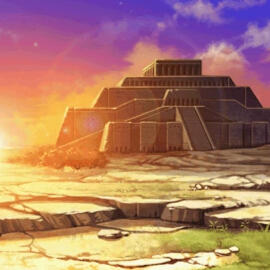
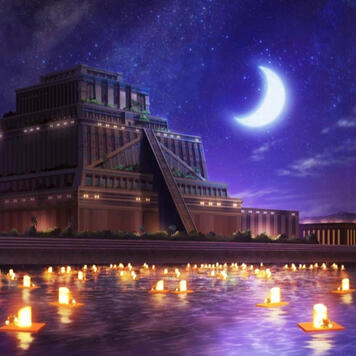
Before her birth, her father, Lugalbanda, made a deal with Sefar, in order to be spared, allowing Gilgamesh to be born.
Born with a body that was of the highest grade by mortal standards and knowledge reaching truth, Gilgamesh was born, designed, as king and the Wedge of Heaven to connect the rising humans and the fading gods. She was sent to ensure the humans and bind the earth slowly leaving the Age of Gods. She was a being embodying the two life sets of life forms, with the blood of those who had ruled and the blood of those who would rule from thereon. She was to be the ultimate neutral party able to discern their respective failings, adjudicating from their respective positions. During her childhood, she loved the gods instead of humanity, but the gods created Enkidu at that time to punish the arrogant king.
Enkidu observed the young Gilgamesh, but could not understand the need to punish such an amiable, ideal king who was praised and lauded by her infatuated subjects. There could be no flaw that required correction, and the only problem was that she did not submit to the gods even if she did respect them. Enkidu was forced to admit that the gods had been correct as he watched the girl grow into a young woman. Practicing absolutism, oppression, duress, levies, and the utmost decadence from self-interest, the people of the kingdom lamented the change, and even the gods were perplexed at the extent of the expected transformation.
The reason was simply that she had been born with the conclusion already drawn, existing independently as a being neither fully divine or human. She acquired the characteristics of both, so her field of vision reached even past what the gods were able to comprehend. Her overwhelming power bred overwhelming isolation, but her strength of self kept her from abandoning her kingship or fleeing from the mission imposed upon her. Through revering the gods and loving humanity, she decided to follow the path to its conclusion by deposing the gods and loathing humanity.
Friendship

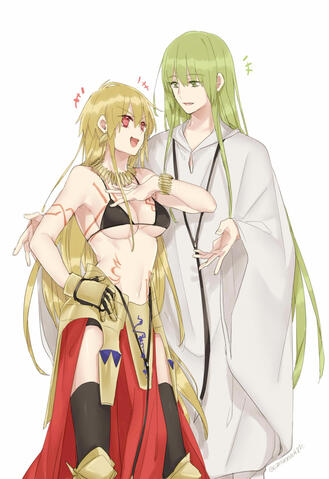
Gilgamesh encountered Enkidu for the first time outside of the Temple of Uruk, who immediately stated that he would reprimand the King and rectify her arrogance. They entered a battle that spanned several days, and Gilgamesh was forced to use all her strength to match her transforming opponent. She was either angered or surprised at having found her equal for the first time, insulting Enkidu as a clod of mud. She was forced to draw out her treasures that had been carefully stored away, marking the first use of the Gate of Babylon as a weapon, and although it was a reluctant and forced humiliation at first, she eventually began to enjoy it and brought them out without regret.
She eventually emptied the vault, and Enkidu was left with only a tenth of his clay. Rather than continue, Gilgamesh let herself fall backwards onto her back while bursting with laughter, Enkidu following in suit. She remarked that there would only be one chance to strike for each of them, and without any means of defense, it would leave only two foolish corpses. Enkidu was never able to interpret if that meant it was a tie or if Gilgamesh wanted to make it so that there would only be one corpse. Enkidu asked, "Do you not regret the treasures you have spent?" to which she replied in a bright voice, "Why, if it's someone I should use it on, then it's not unthinkable to do him the favor."
Gilgamesh and Enkidu became close friends afterward, marking the one and only story of eternally unchanging worth in all the world. They worked side by side, and Gilgamesh noted that her vault started to become disordered after having begun utilizing weapons as projectiles, calling it a bad habit. Looking towards Humbaba, the guardian of the forest and beast of the gods, Gilgamesh decided to seek out and defeat it. They did so with their combined strength, but Enkidu was left confused by the action. It had not been an order from the gods, and it could not have been for her people who suffered under her.
Gilgamesh told him that it was part of purging the evils of the world to protect Uruk, but Enkidu could not understand why she would care about those she tyrannized. Gilgamesh explained her way of protecting humanity, causing Enkidu to fully realize the source of her isolation. Enkidu stated that Gilgamesh took the path of observation, causing Gilgamesh to smile embarrassedly like in her childhood and speak of it. In response to her passion, Enkidu pledged himself as a tool to Gilgamesh afterward, but Gilgamesh reprimanded him, explaining to him that he was her friend. Enkidu believed it was the only time Gilgamesh had ever shown relief.
She became the greatest and richest king on Earth, who eventually acquired all the treasures of the world. Uruk became unprecedentedly prosperous, and Gilgamesh was considered so powerful that even the gods could not ignore her existence. One goddess, Ishtar the goddess of fertility, even fell in love with Gilgamesh and proposed marriage to the perfect king. She rejected her immediately because she knew her to be a witch who was unfaithful, cruel, and the corruptor of all men. She became furious, feeling that she had insulted her, and went to her father, the god Anu, to get revenge. She begged him to unleash the Bull of Heaven.
The unopposable beast of the gods caused seven years of starvation and destruction on the earth. Working together, Gilgamesh and Enkidu defeated it after binding it with the Chains of Heaven, causing the dark clouds covering the world to fade and saving the land from the flood. Ishtar's reputation was once again crushed, and her fury did not abate. She requested they be put to death for the sin of slaying a beast of the gods with the body of a human. Her request was granted, and Enkidu, created by the gods, was unable to defy the decree.
He slowly weakened and was returned to clay, as Gilgamesh desperately held onto the crumbling clod in her arms. She was angered by this, believing that she was the one who deserved retribution should it be required. Enkidu attempted to assuage her by telling Gilgamesh that he was only one of the many treasures in Gilgamesh's collection, that he would find countless more greater than him in time. Gilgamesh instead declared, "You do have worth. You alone have this worth. I hereby declare: In all this world, only one shall be my friend. Thus---not for all eternity shall his worth ever change." Enkidu returned to his original state afterward, leaving nothing behind but Gilgamesh's thunderous cry.
Appearance
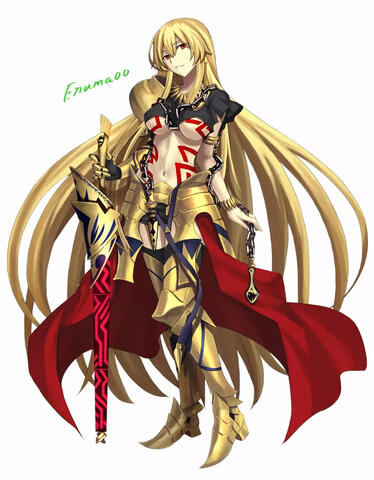
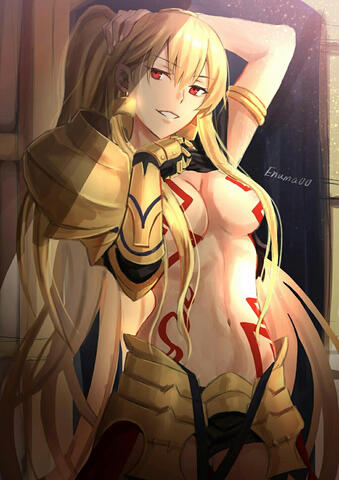
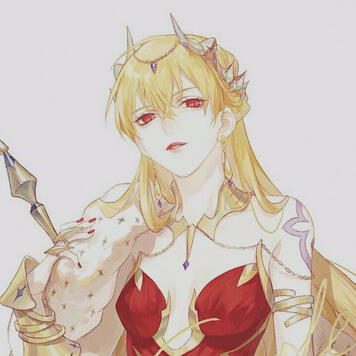
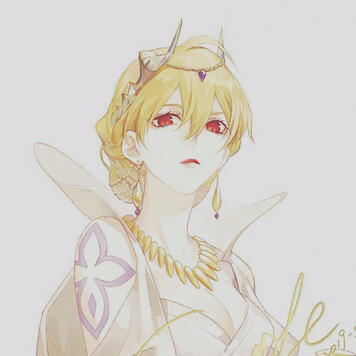
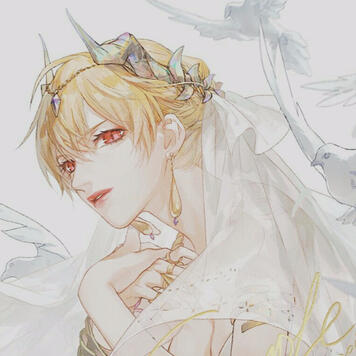
Gilgamesh is a young woman with long golden hair. She is described as beautiful with an elegant face, and her eyes, crimson like blood, are visibly not those of a human and give off a mysterious radiance that makes people wither. She has a "perfect, Golden-proportioned body" described as emanating majesty that makes flames surrounding her afraid to come close, and her very soul glows golden. She normally wears golden armor that makes a heavy first impression on those she encounters. While fighting at full power in Fate/hollow ataraxia, she gains a number of red tattoos on her body that are not normally present.
She is often referred to as the "golden Archer" and the "golden-sparkling Servant," and Rider generally calls her "Goldie." She is similarly called Gold-glitter (金ピカ, Kin-Pika?) due to her hair, armor, and golden soul, but Rin's reasoning behind the name has less to do with the color of her hair and more simply due to the fact that she thinks she looks like she is living a rich and luxurious life. She looks like a regular foreigner to both Rin and Archer, and she does not openly give off the impression of a Servant or Master due to her body being made of flesh after the Fourth Holy Grail War.
She likes to wear casual clothes, "playing attire" to ward off boredom from being in spirit form, when not in battle, later becoming knowledgeable on the latest fashion trends after living in modern society for ten years. She has collected a number of casual outfits.
Personality
Gilgamesh greatly differs from most of the sovereigns and leaders in the history of humanity. She placed herself before her nation and the people, and she had neither the curiosity nor desire to conquer, possibly because she had too much in the beginning. She takes the time to enjoy herself, mastering every treasure and every pleasure. With conviction to treat good and evil equally, she has no need for other ideologies and ways of life when the absolute basis is "herself." Her actions and way of life left her alone, so Enkidu compared rectifying her attitude to rectifying her solitude.
She follows a simple style of ruling, acquiring worthy treasures and guarding them. She exterminates those that stand in the way of her enjoyment without exception. All living beings are "something that is about to die" or "something that will one day die." If she decides that there is a "being that should die this moment", she will simply execute the sentence no matter if they should be a sage or a god. If it is an astute judgment synonymous to universal truth, or even a misrule during a drunken stupor, anything carried out by her, the absolute king, becomes the indisputable sentence of the king.
She is extremely arrogant and selfish, believing herself to be the sole potentate and only king of the world even many millennia after her death. She cannot acknowledge the authority of anyone, including that of other kings and especially that of the gods. She considers all those around her as inferior due to this fact, viewing all other kings and heroes as a collection of mongrels, and loathes any individual who would try to be on the same level as her. The only exception is Enkidu, who she considered to be her equal and only friend. She responds to Iskander's request to form an alliance with him by saying "It is unfortunate, but I do not require a second friend. Past and future, my companion will only be one."
She believes that all who look upon her, when she honors them with her presence, should be able to recognize her instantly, and feels that the ignorance of not knowing her is worthy of death. If anyone so much as looks upon her with a "lowly and filthy" gaze, it is an intolerable disgrace for a nobleman who claims the title of king more so than anyone else. This is enough to make that person a complete malefactor in her eyes, instantly marked for death. She doesn't view the modern world as worthy of having her rule over it because humanity has become too weak.
Gilgamesh has a natural disposition to collect items for her treasury, which lead to collecting all the treasures of the world. The act of collecting is something that has never brought her true joy due to essentially being on the same level as breathing to her, but she still persists at it nonetheless. She lives by the Golden Rule, only accepting the finest of luxuries, and those who fall to it are utterly blinded by money.
She is prone to underestimating her opponents and views combat as a game of amusement. Her gigantic ego prevents her from acknowledging her opponent as a real threat and she does not battle them seriously. She will properly fight those she respects, or simply utilize more power than necessary on a whim depending on the situation. If her Master happens to grow on her, or she decides that their battle is worth fighting for, then she could become somewhat more willing to use her full power should they will it.
Abilities
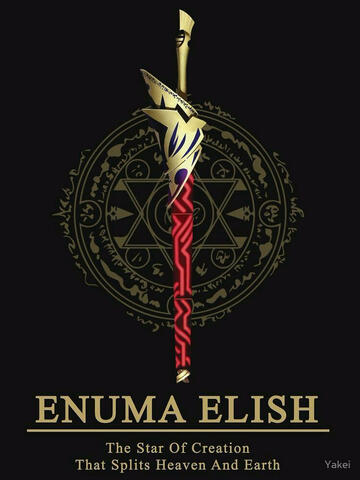
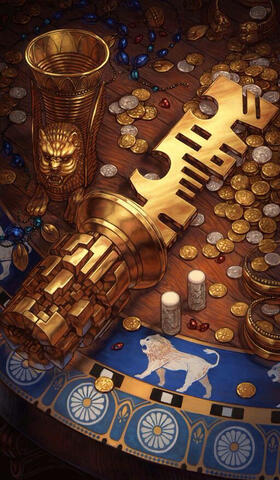
Gilgamesh is the most powerful existence among the Servants in both the Fourth and Fifth Holy Grail War and the strongest Heroic Spirit. She is placed into the Archer class because of her main Noble Phantasm, Gate of Babylon. It grants her access to all of the world's treasures that she collected during her life, which include prototypes of other heroes' Noble Phantasms, and she can launch them as the strongest arrows towards her opponents. While she may sometimes choose to wield them as regular weapons, she mainly fights by raining down an infinite amount of weapons on her opponents. The most trusted Noble Phantasms contained within include Enkidu and Ea. While she has numerous Noble Phantasms, none are indicative of her true identity, and the only person through both Holy Grail Wars to figure out her identity without being told is Rider, though Shirou is able to guess after she gives a number of details about herself. The energy of her soul is worth that of hundreds of thousands of souls, and taking her in is enough to fill a partially-full Lesser Grail even while it lacks several other Servants.
She has the skill Golden Rule, being fated to a life that is filled with riches. It does not measure the percentage of gold in one's body, but the chance of attracting gold in one's life. The level of gold provided by rank A will make the user incredibly wealthy to the point where money trouble will be unknown, allowing her to live the life of a nabob. While it seems unrelated to battle, it plays a great role in arming her. Claiming all the world's treasures as her own, she obtained the originals of Noble Phantasms preserved in her treasury during that period.
She has a very high rank of Charisma with the influence to build a grand empire on a global scale. She is often praised as the greatest king, so her ability to command and lead great armies is excellent. It is a rare talent, and even a B rank is sufficient enough to lead a nation. Gilgamesh has a rank of A+, making it no longer a matter of popularity or skill, but closer to something like sorcery or curse. Any army led by her will have a tremendous increase in abilities because an egotistical Gilgamesh radiating with self-confidence is sure to boost the morale of her army to an extremely high level.
She would normally possess the highest rank of Divinity among all Heroic Spirits due to being 2/3 God. She is at a level even exceeding Heracles, the son of Zeus who ascended to the Pantheon after death. The rank is instead decreased from A+ to B because of her hatred of the gods, who killed her only companion, Enkidu, unleashed the Bull of Heaven onto the earth, and caused her much trouble in her life.
One of her Noble Phantasms grant Gilgamesh the ability to levitate high into the air, to the point of being able to casually float over 100 meters above the opponent and remain perfectly still while having an all-out battle with Enkidu. She is capable of freely controlling it, allowing her to briefly descend to the ground before quickly returning to the air shortly after.
She did not have any abilities to resist magecraft during life, so she only gains Magic Resistance as the class ability of the Archer class. She obtains C rank under Tokiomi, allowing her to completely nullify magecraft under two verses, but she is still susceptible to High Thaumaturgy and Greater Rituals. It is lowered under Kirei due to her lack of magical energy, and remains at only the minimal level, rank E, that provides light damage mitigation against magecraft rather than full neutralization. The state of her Magic Resistance matters little, as she is able to neutralize most magecraft with her many items that defend against it. Her armor and a shield are able to repel A rank magecraft with ease. Overall, she is much more likely to simply unleash a raging wave of Noble Phantasms against "mongrels" impeding the king by attempting to use large-scale spells, completely crushing them without even giving them the time to cast.
Writer's Notes
All informations are taken from the Wikipedia. The differences are only the gender and headcanons. This is still the same Gilgamesh but in a woman vessel. It's similar with Arthur Pendragon and Artoria Pendragon.
Please be aware of her rude IC
All arts belong to the respectful artists
Mostly focus on Fate/Zero, Fate/Stay Night, Fate/Unlimited Blade Works, Fate/Extra CCC
Plots can be discussed in DM, don't hesitate to knock or simply throw me a random bait
Thank you for wasting your time reading all of this. I really, really appreciate it. Love you, mwah 😘